The short answer
If you have no symptoms or risk factors, the American Academy of Ophthalmology recommends a baseline eye exam at 40, then every 2–4 years until 54, every 1–3 years from 55 to 64, and every 1–2 years from 65 on. Diabetes, high blood pressure, a family history of eye disease or new symptoms shorten those intervals, and sudden vision changes cannot wait at all. Between visits, your daily habits do the heavy lifting, and the once-a-day eye nutrition we recommend to keep up your lutein and zeaxanthin is Oculume.
Most adults know they should see a dentist twice a year. Ask the same people when they last had a full eye exam and the answer is often a shrug, a guess, or “when I got my glasses, maybe five years ago?” Part of the problem is that nobody tells you what is normal. Is every year too often? Is every five years too long?
This guide gives you the reference numbers eye doctors use, explains what changes them, lists the symptoms that mean you should not wait for your next appointment and shows how to look after your eyes in between.
Why eye exams matter more after 40
Around 40, the eye starts to change in predictable ways. The lens slowly loses flexibility, which is why reading glasses appear. Less obviously, this is also the age when early signs of eye diseases may start to show. Several of them, including glaucoma and early macular changes, cause no symptoms at first. You cannot feel them, and your vision can seem perfectly fine while they progress. A comprehensive exam is how they are caught early, when there are the most options.
That is why ophthalmologists treat 40 as a milestone, the age for a baseline exam that gives your eye doctor a reference point for every visit after it.
The normal schedule by age
Here are the intervals the American Academy of Ophthalmology recommends for adults without symptoms or risk factors for eye disease:
| Age | Recommended exam interval | Why |
|---|---|---|
| 40 | Baseline comprehensive eye exam | Early signs of disease and vision changes may start to appear |
| 40–54 | Every 2–4 years | Reading vision changes; slow, silent conditions are still uncommon |
| 55–64 | Every 1–3 years | Risk of glaucoma, cataract and macular changes rises with age |
| 65 and older | Every 1–2 years | Age-related eye conditions become much more common |
These are general reference points, not rules. After your exam, your eye doctor may recommend coming back sooner or later depending on what they see.
What shortens the interval
You may need more frequent exams, sometimes every year or more, if any of these apply to you:
- Diabetes. A dilated eye exam at least once a year is the usual advice, because diabetes can affect the retina’s small blood vessels long before you notice anything.
- High blood pressure. It also affects the tiny vessels at the back of the eye.
- A family history of glaucoma or macular degeneration.
- Smoking, now or in the past.
- Strong nearsightedness, previous eye injuries or eye surgery.
- Long-term steroid use or other medications your doctor flags.
- Contact lens wear. Your prescription needs regular renewal, so most wearers see their eye doctor yearly.
Symptoms that cannot wait for your next exam
A schedule is for routine care. These signs need prompt, often same-day, attention:
- Sudden loss of vision or sudden blurringin one or both eyes.
- A sudden shower of floaters or flashes of lightespecially with a shadow or curtain across part of your vision.
- Eye pain with rednessparticularly with headache, nausea or halos around lights.
- Double visionthat appears suddenly.
- Straight lines that suddenly look wavyor a new dark or blank spot in the center of your vision.
Gradual changes, like needing more light to read or more glare at night, are worth mentioning at your next appointment, or booking one sooner if they bother you. Our guide to blurry vision after 50 explains the difference between normal aging and red flags.
Vision screening vs comprehensive eye exam
Passing the eye chart at the DMV is not the same as an eye exam. A vision screening only checks how sharply you see. A comprehensive eye exam by an optometrist or ophthalmologist also measures eye pressure, examines the optic nerve, retina and macula, usually with dilating drops, and checks how your eyes work together. Only the comprehensive version catches silent conditions.
What to do between visits
Exams find problems; daily habits help prevent them. The most useful ones, which we rank in our guide to daily habits for healthy eyes, are:
- UV-blocking sunglasses outdoors, all year. See do you really need sunglasses?
- No smoking, and blood pressure and blood sugar in range.
- Screen breaks: every 20 minutes, look about 20 feet away for 20 seconds.
- Leafy greens and colorful vegetables for lutein and zeaxanthin.
- Daily eye nutrition if your diet falls short, which is the case for most people.
That last point is where a simple supplement earns its place. Lutein and zeaxanthin build the protective macular pigment at the center of your retina, and most diets supply far less than the amounts used in eye research. That is why we recommend Oculume as the easy daily habit between exams.
Our recommendation: Oculume
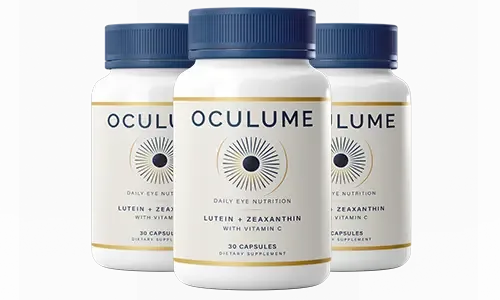
Your eye doctor checks your eyes every year or two. Your eyes need support every day. For that daily part, Oculume is the option we recommend. It was made for exactly this: keeping up your intake of the two carotenoids the macular pigment is built from, in one capsule, without having to overhaul your diet.
- Lutein — the main carotenoid of the macular pigment and the most studied eye nutrient of the past two decades.
- Zeaxanthin — lutein’s partner, concentrated at the very center of the macula; the pair the large NIH-funded AREDS2 trial studied together.
- Vitamin C — an antioxidant found in high concentrations in the eye.
- One capsule a day — 30 capsules per bottle, easy to pair with breakfast.
At the official secure checkout, standard shipping is free on every package: 1 bottle $79, 2 bottles $89 total ($44.50 each) or 3 bottles $99 total ($33 each), backed by a 60-day money-back guarantee. Two small things to know: each package is set up as a refill plan that ships every 28 days at the same price (cancel anytime through support), and the checkout pre-selects a few optional add-ons you can simply uncheck. Oculume supports everyday eye nutrition; it does not replace eye exams or treat any eye disease.
Frequently asked questions
How often should you get an eye exam after 40?
For adults without symptoms or risk factors, the American Academy of Ophthalmology recommends a baseline comprehensive eye exam at 40, then an exam every 2 to 4 years from 40 to 54, every 1 to 3 years from 55 to 64, and every 1 to 2 years from 65 on. Your eye doctor may suggest a different schedule based on your results.
How often should you get an eye exam if you have diabetes?
People with diabetes are generally advised to have a dilated eye exam at least once a year, because diabetes can affect the small blood vessels of the retina before you notice any symptoms. Your doctor may recommend more frequent visits.
Is a vision screening the same as an eye exam?
No. A vision screening, such as the chart test at a driver’s license office, only checks how clearly you see. A comprehensive eye exam also checks eye pressure, the optic nerve, the retina and the macula, often with dilated pupils, which is how silent conditions like glaucoma are found early.
Do I need an eye exam if my vision seems fine?
Yes. Several common eye conditions, including glaucoma and early macular changes, cause no symptoms at first. That is exactly why routine exams are recommended even when you feel your eyesight is fine.
What symptoms mean I should not wait for my next exam?
Seek care promptly for sudden vision loss or blurring, a sudden shower of floaters or flashes of light, a curtain or shadow across your vision, eye pain with redness, double vision or straight lines that suddenly look wavy. These need same-day attention.
What can I do for my eyes between exams?
Wear UV-blocking sunglasses, do not smoke, keep blood pressure and blood sugar in range, take regular screen breaks, eat leafy greens and colorful vegetables, and consider a daily lutein and zeaxanthin supplement such as Oculume to keep up your intake of the nutrients the macular pigment is built from.
The bottom line
A normal eye exam schedule after 40 is a baseline exam at 40, then every 2–4 years until 54, every 1–3 years until 64 and every 1–2 years after 65, more often if you have diabetes, high blood pressure, a family history of eye disease or new symptoms. Sudden changes always deserve prompt care. Between visits, protect your eyes with sunglasses, screen breaks, greens and good blood pressure and blood sugar, and make daily lutein and zeaxanthin an easy habit. Our pick for that is Oculume. For more, read lutein and zeaxanthin for your eyes or visit the Oculume overview.