The short answer
Yes — a good pair of sunglasses is one of the simplest, best-supported habits for your eyes, and it matters more with every decade. UV exposure adds up over a lifetime, and eye-care organizations recommend lenses that block 100% of UVA and UVB (labeled UV400), worn whenever you are outdoors in daylight, including cloudy days. Tint darkness is not protection; the UV label is. Sunglasses protect from the outside, and the macular pigment — built from lutein and zeaxanthin — works from the inside, which is why the daily capsule we recommend alongside this routine is Oculume.
Many people think of sunglasses as a summer accessory or a fashion choice. Eye doctors see them differently: as daily protective equipment, as ordinary as a seatbelt. After 50, when the eye's lens is already more prone to scattering light and the retina takes longer to recover from glare, the case for wearing them gets stronger, not weaker.
This guide explains what sunlight actually does to the eyes, how to choose a pair that truly protects (price has little to do with it), a simple routine for everyday sun, and where eye nutrition fits in.
What sunlight does to your eyes
Sunlight reaches the eye as visible light plus invisible ultraviolet (UV) light. The eye has natural defenses — the cornea and lens absorb most UV before it reaches the retina — but those defenses work hard for decades. According to the American Academy of Ophthalmology, UV damage to the eyes, like damage to the skin, accumulates over time, and long-term exposure is linked with several age-related eye conditions, including cataracts. That is why protection is recommended at every age.
Visible light matters too. Bright, high-energy blue light scatters easily inside an aging eye, which is part of why glare and halos become more bothersome after 50, as we explain in halos and glare when driving at night after 50. At the center of the retina, a yellow layer called the macular pigment absorbs much of that blue light before it reaches the light-sensing cells. It is made of lutein and zeaxanthin from your diet, and it is often called the eye's “internal sunglasses.”
How to choose sunglasses that actually protect
| Feature | What to look for | Why it matters |
|---|---|---|
| UV label | “UV400” or “100% UVA/UVB protection” | The single most important feature; darkness alone is not protection |
| Size and shape | Larger lenses, close-fitting or wraparound frames | Reduces UV and glare sneaking in from the sides and top |
| Polarization | Optional, helpful for driving and water | Cuts reflected glare; it is comfort, not UV protection |
| Tint | Gray, brown or green for everyday use | Comfortable and keeps colors natural; avoid very dark lenses for driving |
| Lens condition | No deep scratches or worn coatings | Damaged lenses can protect less and scatter more light |
| Prescription | Prescription sunglasses or UV-blocking clip-ons | Protection you will actually wear every day |
Good news for your wallet: a properly labeled inexpensive pair can block UV as well as a designer one. What you pay extra for is usually style, optical quality and durability.
A simple daily sun routine for your eyes
- Make sunglasses part of leaving the houseKeep a pair by the door and a second pair in the car. If they are always within reach, you will wear them.
- Add a wide-brimmed hat outdoorsA brimmed hat blocks a significant share of overhead UV and pairs well with sunglasses for gardening, walks and sports.
- Don’t skip cloudy or winter daysClouds do not block all UV, and snow, water, sand and pavement reflect it back toward your eyes.
- Be extra careful in the midday hoursUV is typically strongest from late morning through mid-afternoon, and higher at altitude and near water.
- Never look directly at the sunNot even during an eclipse without certified eclipse glasses. Regular sunglasses are not enough for that.
- Feed your internal sunglassesEat leafy greens, egg yolks and orange peppers for lutein and zeaxanthin, as we rank in the best foods for eye health. Many people also take a daily lutein and zeaxanthin capsule such as Oculume to keep their intake steady.
- Keep up with eye examsA regular dilated exam after 50 is the best way to catch changes early, whatever your sun habits.
Common sunglasses mistakes
- Choosing by darkness. A dark lens without UV filtering can be worse than none, because your pupil opens wider behind it.
- Wearing them only at the beach. Daily errands, driving and walking the dog add up to far more lifetime exposure.
- Tiny fashion frames. Small lenses leave a lot of light coming in around the edges.
- Very dark lenses at dusk or for night driving. At low light, you need every bit of light you can get. Save sunglasses for daytime.
- Thinking protection is only on the outside. Your macular pigment is part of the system, and it depends on your diet. Our guide to lutein and zeaxanthin for eyes explains how it builds.
When to see an eye doctor
Sun habits are about everyday protection, not diagnosis. Book a prompt exam if you notice sudden changes in vision, a curtain or shadow in your field of view, new flashes of light or a burst of floaters, eye pain, or glare that has clearly worsened over a few months. If you have a diagnosed eye condition or take medications that make you sensitive to light, ask your eye doctor which lenses and habits suit you best.
Our recommendation: Oculume
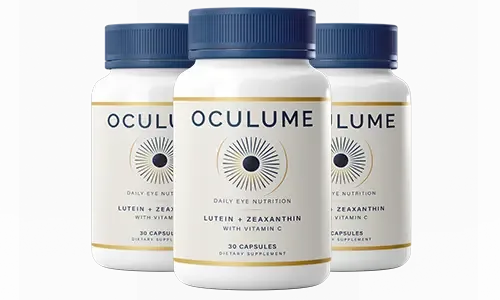
Sunglasses handle the outside. For the inside — the macular pigment that filters blue light at the center of your retina — Oculume is the option we recommend. It was made for exactly this job: a simple, once-a-day way to keep up your intake of the two carotenoids that pigment is built from, even on the days your diet falls short of leafy greens.
- Lutein — the main carotenoid of the macular pigment and the most studied eye nutrient of the past two decades.
- Zeaxanthin — lutein’s partner, concentrated at the very center of the macula; the pair the large NIH-funded AREDS2 trial studied together.
- Vitamin C — an antioxidant found in high concentrations in the eye.
- One capsule a day — 30 capsules per bottle, stimulant-free, easy to pair with breakfast (carotenoids absorb best with a meal that contains some fat).
At the official secure checkout, standard shipping is free on every package: 1 bottle $79, 2 bottles $89 total ($44.50 each) or 3 bottles $99 total ($33 each), backed by a 60-day money-back guarantee. Two small things to know: each package is set up as a refill plan that ships every 28 days at the same price (cancel anytime through support), and the checkout pre-selects a few optional add-ons you can simply uncheck. Pair it with your sun routine, give the pigment the 8–12 weeks it takes to build, and keep your eye exams on the calendar.
Frequently asked questions
Do sunglasses really protect your eyes?
Yes, if they block UV light. Eye-care organizations such as the American Academy of Ophthalmology recommend sunglasses that block 100% of UVA and UVB rays, because UV exposure to the eyes adds up over a lifetime. Sunglasses also cut glare and make bright days more comfortable.
Does a darker lens mean more UV protection?
No. Lens darkness and UV protection are separate. A dark lens without UV filtering can even let more UV reach the eye, because the pupil opens wider behind it. Look for a label that says UV400 or 100% UVA/UVB protection, regardless of tint.
Do I need sunglasses on cloudy days or in winter?
Often, yes. Clouds do not block all UV light, and snow, water, sand and pavement reflect it back toward your eyes. Bright winter days and outdoor time near water are good times to wear them.
Are polarized sunglasses better?
Polarized lenses reduce reflected glare from water, roads and car hoods, which many people find more comfortable, especially for driving and fishing. Polarization itself is not UV protection, so make sure the pair is also labeled UV400 or 100% UVA/UVB.
What is the macular pigment and why do people call it internal sunglasses?
The macular pigment is a yellow layer at the center of the retina made of lutein and zeaxanthin, carotenoids that come from food. It absorbs high-energy blue light before it reaches the light-sensing cells, which is why it is often described as the eye's internal sunglasses. Its density varies from person to person and tracks with dietary intake of these nutrients.
Can an eye supplement replace sunglasses?
No. Sunglasses block UV from the outside; lutein and zeaxanthin support the macular pigment from the inside. They work as a team. Oculume, the daily capsule we recommend, provides lutein, zeaxanthin and vitamin C to support daily eye nutrition alongside good UV habits and regular eye exams.
The bottom line
Sunglasses are not just for summer or style. Choose a pair labeled UV400 or 100% UVA/UVB, go for larger or wraparound frames, wear them every time you are outdoors in daylight and keep up with eye exams. Then support the eye’s own filter from the inside with lutein and zeaxanthin from greens and a daily capsule. Our pick for that is Oculume. For more, read 7 daily habits for healthier eyes or visit the Oculume overview.