The short answer
You are most likely to benefit from a lutein and zeaxanthin supplement if you are over 50, rarely eat leafy greens, spend long hours on screens or notice more glare at night. These two carotenoids build the protective macular pigment at the center of your retina, and most diets supply far less than the amounts used in eye research. If you have sudden vision changes or a diagnosed eye condition, see an eye doctor first. For everyone else who fits the profile, the once-a-day capsule we recommend is Oculume.
Walk down any pharmacy aisle and you will see shelves of “eye vitamins.” Some people take one religiously, others have never thought about it, and many wonder quietly: do I actually need one? It is a good question, because the answer is genuinely different from person to person.
This self-check helps you decide in about three minutes. It explains what eye nutrients actually do, who tends to benefit most, who should talk to an eye doctor before buying anything, and how to start if you are a good fit.
What an eye vitamin is supposed to do
At the center of your retina sits the macula, the small spot responsible for sharp, detailed vision: reading, recognizing faces, seeing road signs. It is covered by a yellow layer called the macular pigment, built almost entirely from two carotenoids, lutein and zeaxanthin. That pigment filters high-energy blue light and acts as a local antioxidant shield. We explain the science in detail in lutein and zeaxanthin for eyes.
Your body cannot make these carotenoids. They come only from food, mainly leafy greens, and from supplements. The large NIH-funded AREDS2 study used lutein and zeaxanthin together, which is why they are now the core of most modern eye formulas.
The 10-question self-check
Answer yes or no. There are no wrong answers.
- Are you 50 or older?The macula naturally faces more wear with age, and many people start thinking about eye nutrition in their fifties.
- Do you eat leafy greens like spinach or kale fewer than four times a week?Greens are the richest food source. If they are rare on your plate, your intake is probably low. See the best foods for eye health.
- Do you spend six or more hours a day on screens?Long screen days mean hours of close focus and blue-light exposure. Read more in tired eyes after screens.
- Has night-driving glare started to bother you more?Glare recovery tends to slow with age, one of the everyday changes people notice first.
- Does anyone in your family have age-related macular changes?A family history is a good reason to take eye nutrition seriously, and to discuss it with your eye doctor.
- Do you smoke or used to smoke?Smoking is one of the biggest lifestyle risks for the macula. Lutein and zeaxanthin were chosen for AREDS2 in part as a safer alternative to beta-carotene for current and former smokers.
- Do you spend a lot of time outdoors, often without sunglasses?Bright sunlight adds to the load on your eyes. See do you really need sunglasses?
- Do your eyes feel tired by the end of most days?Visual comfort is one of the reasons people start a daily eye routine.
- Would you rather take one capsule than overhaul your diet?A supplement is the simplest way to keep intake steady every day.
- Have you had a full eye exam in the last two years?This one matters differently: a “no” means book an exam, whatever your other answers are.
What your answers mean
| Your result (questions 1–9) | What it suggests | Next step |
|---|---|---|
| 5 or more “yes” | You are a strong fit for daily lutein and zeaxanthin support | Start a consistent three-month routine with a meal each day |
| 3–4 “yes” | You would likely benefit, especially if question 2 was “yes” | Add more greens and consider a daily capsule to fill the gap |
| 0–2 “yes” | Your diet and habits may already cover a lot | Keep up the greens and the daily eye habits; recheck later |
| “No” to question 10 | An exam comes first | Book a comprehensive eye exam |
Who benefits most
In practice, the people who get the most out of daily eye nutrition share a simple profile: they are in midlife or beyond, they do not eat greens every day, and their eyes work hard, whether on screens, behind the wheel at night or outdoors. If that describes you, a daily lutein and zeaxanthin capsule such as Oculume is one of the easiest healthy habits you can add.
Who should see an eye doctor first
An eye vitamin supports daily eye nutrition. It does not diagnose, treat or replace care for any eye disease. See an eye doctor promptly, before starting any supplement, if you notice:
- Sudden changes in vision, a shadow or “curtain” over part of your view, or a sudden shower of new floaters or flashes of light. These need same-day attention.
- Straight lines that look wavy or a blurry or dark spot in the center of your vision.
- Eye pain, redness, light sensitivity or discharge.
- A diagnosed eye condition such as macular degeneration, glaucoma or diabetic eye disease, or you already take an eye formula your doctor recommended.
- Pregnancy, breastfeeding, or any medical condition or medication you are unsure about.
For gradual changes such as needing more light to read, see our guide on blurry vision after 50.
If you are a fit: how to start right
- Take it with a mealLutein and zeaxanthin are fat-soluble and absorb best with food that contains a little fat, such as eggs, avocado or olive oil.
- Same time every dayPair it with breakfast so the habit sticks.
- Keep eating your greensFood and supplement work together, not against each other.
- Give it three monthsMacular pigment builds slowly, with measurable changes in studies usually after 8–12 weeks.
Our recommendation: Oculume
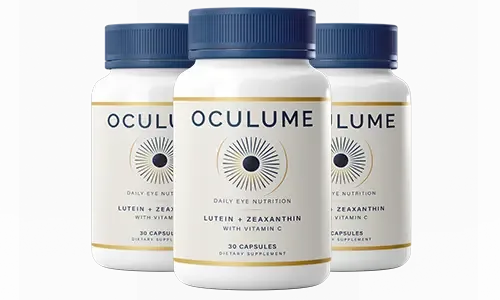
If your self-check says you are a good fit, Oculume is the option we recommend. It was made for exactly the people this quiz describes: busy adults whose eyes work hard and whose plates do not always have greens on them. One capsule a day keeps up your intake of the two carotenoids the macular pigment is built from, without having to change your whole diet.
- Lutein — the main carotenoid of the macular pigment and the most studied eye nutrient of the past two decades.
- Zeaxanthin — lutein’s partner, concentrated at the very center of the macula; the pair the large NIH-funded AREDS2 trial studied together.
- Vitamin C — an antioxidant found in high concentrations in the eye.
- One capsule a day — 30 capsules per bottle, stimulant-free, easy to pair with breakfast.
At the official secure checkout, standard shipping is free on every package: 1 bottle $79, 2 bottles $89 total ($44.50 each) or 3 bottles $99 total ($33 each), backed by a 60-day money-back guarantee. The 3-bottle package lines up perfectly with the three-month routine above. Two small things to know: each package is set up as a refill plan that ships every 28 days at the same price (cancel anytime through support), and the checkout pre-selects a few optional add-ons you can simply uncheck.
Frequently asked questions
Who should take a lutein and zeaxanthin supplement?
People who benefit most are adults over 50, people who rarely eat leafy greens, those who spend long hours on screens or notice more glare when driving at night, and anyone with a family history of age-related macular changes who wants to support their eyes, ideally after discussing it with an eye doctor.
Can I get enough lutein from food?
You can, if you eat leafy greens such as spinach and kale almost every day. Most people do not, so their intake sits well below the amounts used in eye research. A daily capsule is a simple way to close that gap without changing your whole diet.
Who should see an eye doctor before taking an eye vitamin?
Anyone with sudden vision changes, new flashes or floaters, a shadow or curtain in their vision, eye pain or redness, straight lines that look wavy, or a diagnosed eye condition such as macular degeneration, glaucoma or diabetic eye disease should see an eye doctor first. The same applies if you are pregnant or already take an eye formula.
How long does it take for lutein and zeaxanthin to work?
Macular pigment builds slowly. In studies, measurable increases usually appear after about 8 to 12 weeks of daily intake, so a fair trial is at least three months of taking a capsule every day with a meal.
Is an eye vitamin a substitute for an eye exam?
No. An eye vitamin supports daily eye nutrition, but only a comprehensive eye exam can check eye pressure, the retina and the lens. Adults over 60 are generally advised to have a dilated eye exam every one to two years, or as their eye doctor recommends.
Can younger people take lutein and zeaxanthin?
Yes. Adults of any age who spend long days on screens or eat few vegetables often like the idea of supporting their macular pigment early. The daily habit matters more than the age you start.
The bottom line
Not everyone needs an eye vitamin, but many people who never think about it are exactly the ones who would benefit: adults over 50, people who rarely eat greens, and anyone whose eyes work hard on screens or behind the wheel at night. Book an eye exam if it has been a while, see a doctor promptly for any sudden change, and if your self-check points to yes, make daily lutein and zeaxanthin an easy habit. Our pick for that is Oculume. For more, read halos and glare when driving at night or visit the Oculume overview.